 Virginia Tech Dendrology
red spruce Pinaceae Picea
rubens Sarg.

 symbol: PIRU
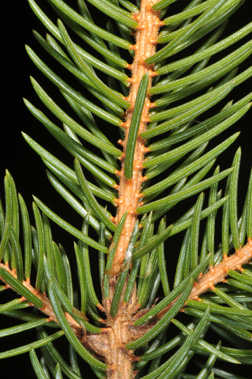
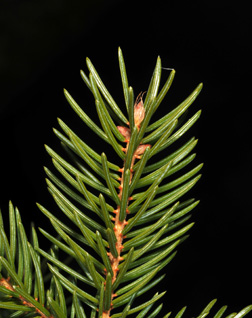
Leaf: Evergreen needles, 1/2 to 5/8 inch long, sharply pointed and four-sided, tending to curve upwards, shiny yellow-green. Each needle borne on a raised, woody peg (sterigma).
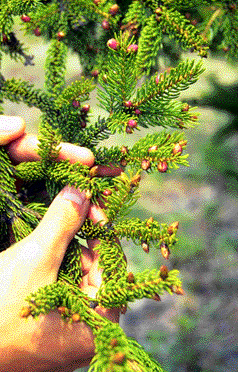
Flower: Species is monoecious; males cylindrical reddish but turning yellow-brown; females purplish green.
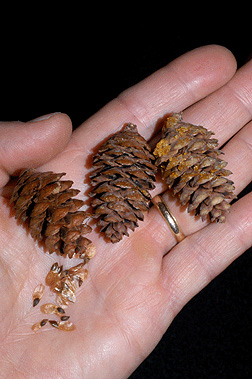
Fruit: Chestnut brown ovoid cone, 1 to 1 1/2 inches long, cone scale margins entire; seed disseminated in the fall and cones tend to drop their first winter.
Twig: Orangish brown, finely hairy (may need a hand lens); as with all spruces, needleless twigs covered by short sterigmata (short pegs); buds orange-brown, small with loose scales.
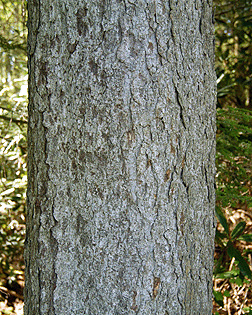
Bark: Grayish brown on surface, more reddish brown beneath with irregular, fine flaky patches.
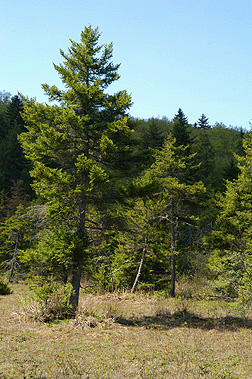
Form: Upright and straight, with a narrow crown; reaching a height of 60 to 80 feet and a diameter of 1 to 2 feet.
Looks like: white spruce
- black spruce
- Norway spruce
- blue spruce
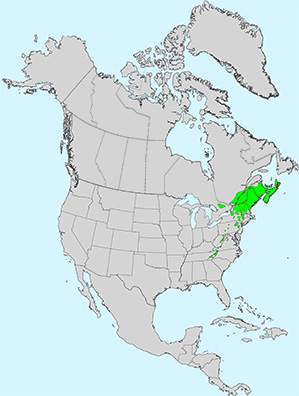
Additional Range Information: Picea rubens is native to North America. Range may be expanded by planting. Download the full-size PDF map.
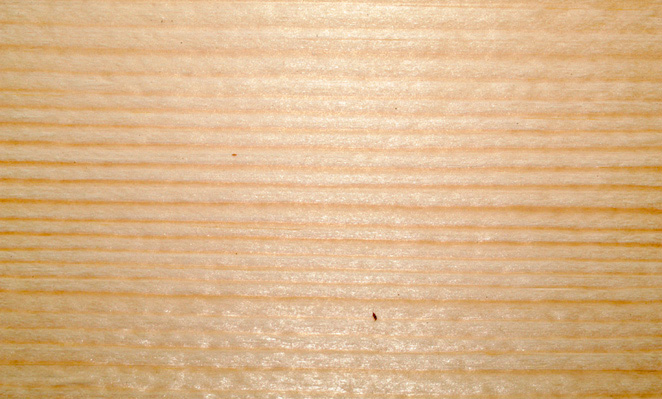
More Information: Wood - Landowner Factsheet
External Links: USDAFS Silvics of North America - USDAFS FEIS Silvics - USDA Plants Database - USDAFS Forest Products Lab
All material 2025 Virginia Tech Dept. of Forest Resources and Environmental Conservation; Photos and text by: John Seiler, Edward Jensen, Alex Niemiera, and John Peterson; Silvics reprinted from Ag Handbook 654; range map source information