 Virginia Tech Dendrology
prickly currant Grossulariaceae Ribes
lacustre (Pers.) Poir.

 symbol: RILA
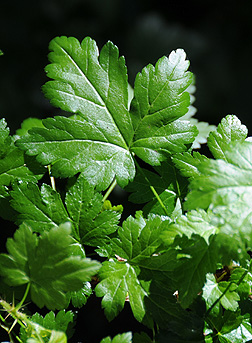
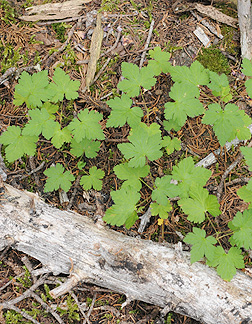
Leaf: Alternate, simple, deciduous, palmately lobed (3 to 5 lobes), round in outline, 1 to 1 1/2 inch, serrated; dark green above but not glandular or hairy; underside is hairy; resembling small maple leaves.
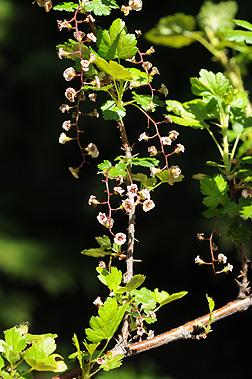
Flower: Species is monoecious; small and saucer-shaped; green to maroon; occur in drooping clusters of 5 to 15 flowers.
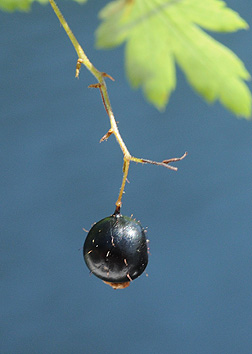
Fruit: Dark purple, pea-sized berries covered with stalked glands; edible but taste is commonly weak; fall free from stalk when ripe.
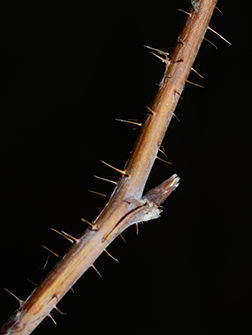
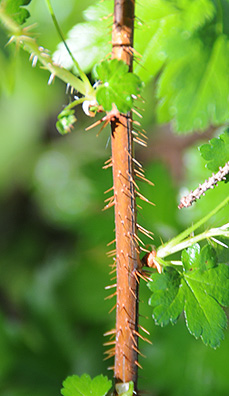
Twig: Young twigs are heavily armed at nodes with multi-parted spines; prickles often occur between the nodes; older twigs mostly unarmed.
Bark: Reddish-brown, smooth.
Form: Spiny, spindly deciduous shrub 3-6’ tall; erect in sun or trailing in shade. May grow alone or in thickets.
Looks like: mountain gooseberry
- spreading gooseberry
- trailing black currant
- snow gooseberry
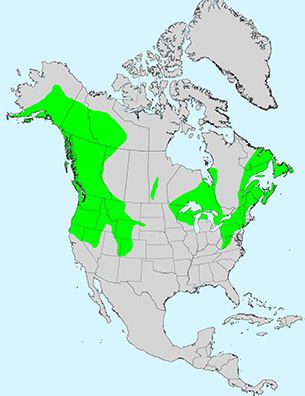
Additional Range Information: Ribes lacustre is native to North America. Range may be expanded by planting. Download the full-size PDF map.
External Links: USDAFS FEIS Silvics - USDA Plants Database
All material 2025 Virginia Tech Dept. of Forest Resources and Environmental Conservation; Photos and text by: John Seiler, Edward Jensen, Alex Niemiera, and John Peterson; Silvics reprinted from Ag Handbook 654; range map source information