 Virginia Tech Dendrology
dawn redwood Cupressaceae Metasequoia
glyptostroboides Hu & W.C. Cheng


 symbol: MEGL8
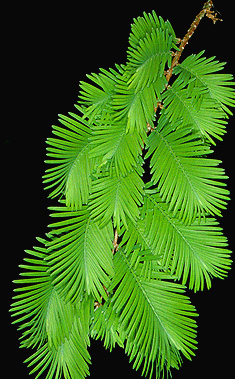
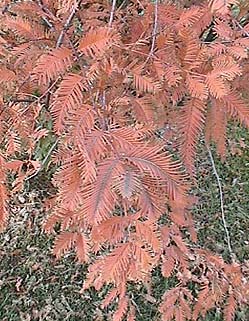
Leaf: Opposite, deciduous, linear, one inch long, flat, generally appearing two-ranked in a flattened display; when growing on deciduous branchlets the leaf/deciduous branchlet structure resembles a feathery pinnately (or bi-pinnately) compound leaf, green to yellow-green.
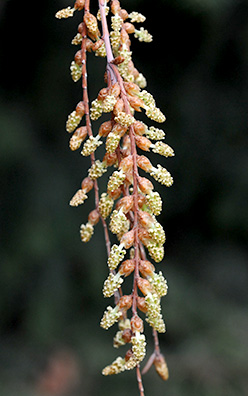
Flower: Species is monoecious; males, light yellow brown, in narrow hanging clusters up to 12 inches long; females, yellow-green, solitary and erect with fused scales.
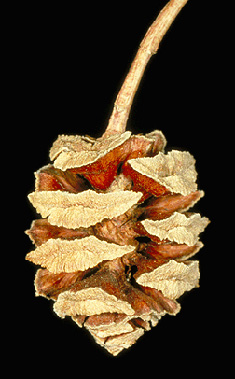
Fruit: Four-sided, box-like cones that hang on long stalks, round to cylindrical in shape, 1/2 to 1 inch long, light brown; peltate shields contain small, winged seeds, matures in late fall.
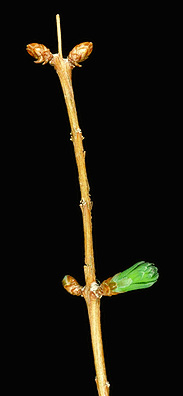
Twig: May be deciduous or not; non-deciduous twigs are slender, light reddish brown in color, smooth, with short, buff colored, opposite, cylindrical buds protruding at right angles; deciduous twigs are two-ranked, resembling pinnately compound leaves.
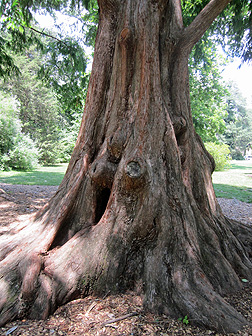
Bark: Reddish brown, fibrous and stringy, develops an irregular fluted pattern, exfoliates in strips, rope-like in appearance.
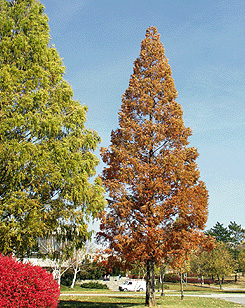
Form: Very straight, single trunk with numerous branches forming a narrow conical crown; capable of reaching heights well over 100 feet tall.
Looks like: baldcypress
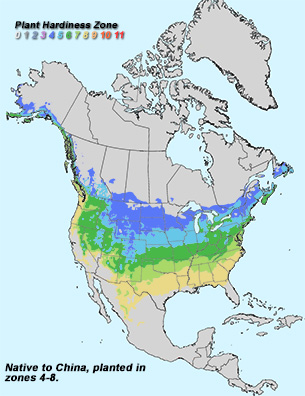
Additional Range Information: Metasequoia glyptostroboides is planted in the USDA hardiness zones shown above and is not known to widely escape cultivaton. Download the full-size PDF map.
More Information: Fall Color
External Links: USDA Plants Database - Horticulture Information
All material 2025 Virginia Tech Dept. of Forest Resources and Environmental Conservation; Photos and text by: John Seiler, Edward Jensen, Alex Niemiera, and John Peterson; Silvics reprinted from Ag Handbook 654; range map source information