 Virginia Tech Dendrology
monkeypuzzle tree Araucariaceae Araucaria
araucana (Molina) K. Koch

 symbol: ARAR23
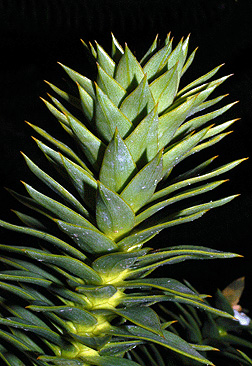
Leaf: Distinctive, armor-like, scale-like, triangular leaves, persist for 10 to 15 years, sometimes longer on the trunk, ovate-lanceolate in shape, 1 to 2 inches long, shiny green on both surfaces but surface marked with longitudinal lines and stomata on both faces.
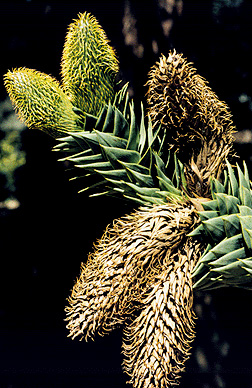
Flower: Species can be dioecious or monoecious; male cones can be solitary or in groups, start out erect but become pendant, yellowish-brown, 1/4 to 1/2 inch long, 2 inches wide, with 20 whorled scales. Immature female cones are large, globular, and erect; take 2 to 3 years to develop.
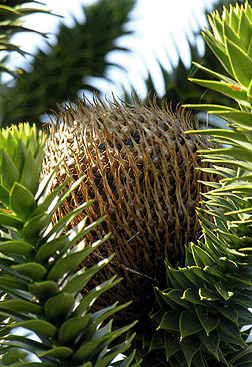
Fruit: Female cones are erect, globular, dark brown, and 4 to 7 inches long by 3 to 6 inches wide, scales have long triangular recurved points; developing in 2-3 years and falling off at maturity; seeds are brown to orange, triangular in shape, 1 to 1 1/2 inches long, the nut is long and narrow with 2 small even wings that are denticulate at the top.
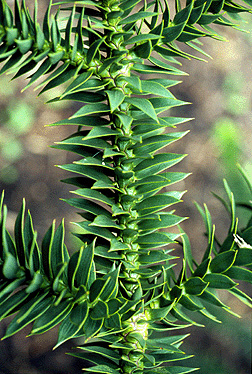
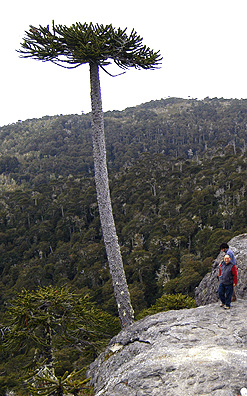
Twig: The lateral branches grow horizontal or slightly pendant from the main trunk. They resemble the tails of monkeys holding onto the trunk.
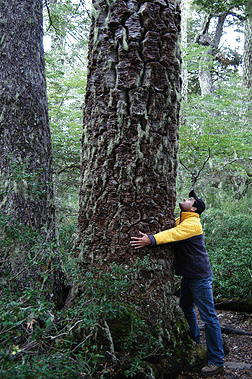
Bark: Gray-brown, resinous, smooth, and marked with rings made by old branch scars.
Form: A pyramidal shaped tree 90 to 130 feet tall and 3 to 4 feet in diameter. The branches grow horizontally in whorls of five in opposite pairs.
Looks like: Norfolk pine
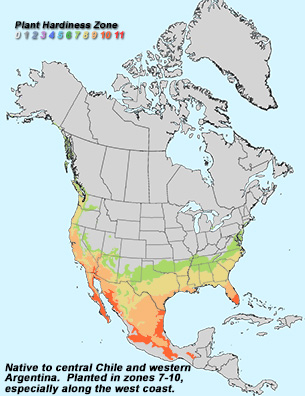
Additional Range Information: Araucaria araucana is planted in the USDA hardiness zones shown above and is not known to widely escape cultivaton. Download the full-size PDF map.
External Links: USDA Plants Database - Horticulture Information
All material 2025 Virginia Tech Dept. of Forest Resources and Environmental Conservation; Photos and text by: John Seiler, Edward Jensen, Alex Niemiera, and John Peterson; Silvics reprinted from Ag Handbook 654; range map source information