 Virginia Tech Dendrology
crucifixion thorn Simaroubaceae Castela
emoryi (A. Gray) Moran & Felger

 symbol: CAEM4
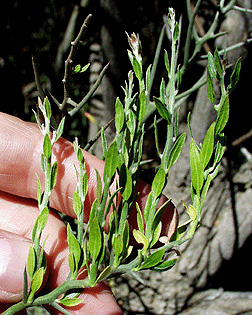
Leaf: Mostly leafless, alternate, narrowly ovate (scale-like), 1/4 to 1/2 inch long.
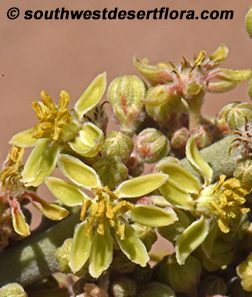
Flower: Species is dioecious; small (1/4 inch), numerous petals in tight, branched clusters near ends of twigs, yellowish to purplish-green, appearing in mid-summer.
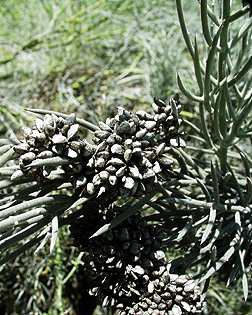
Fruit: Persistent, dark brown, dry and woody (1/4 inch), occurring in a circular, flat, star-shaped, persistent cluster (1/2 inch across), many of these "star" clusters occur in dense, larger clumps at the end of the twigs.
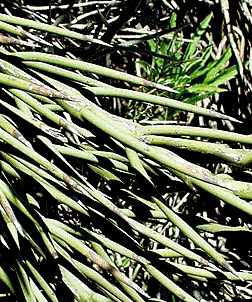
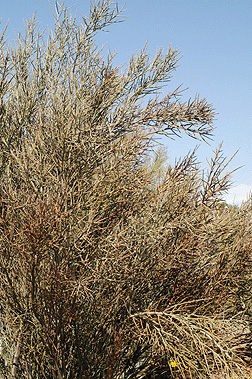
Twig: Stout, blue, gray or yellow-green, maybe finely hairy, very rigid with numerous stout thorns.
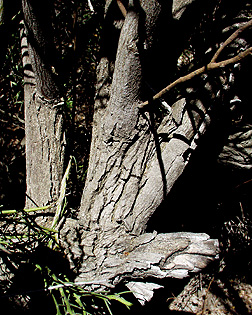
Bark: Gray-brown, narrow furrows with smooth ridges.
Form: A large (up to 10 feet), sprawling, dense shrub with a round crown, often with descending branches heavy with thorns.
Looks like: allthorn
- yellow paloverde
- desert smoke tree
- crucifixion thorn
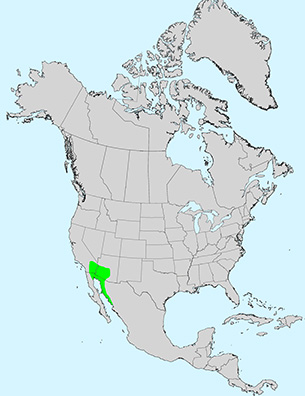
Additional Range Information: Castela emoryi is native to North America. Range may be expanded by planting. Download the full-size PDF map.
External Links: USDA Plants Database
All material 2025 Virginia Tech Dept. of Forest Resources and Environmental Conservation; Photos and text by: John Seiler, Edward Jensen, Alex Niemiera, and John Peterson; Silvics reprinted from Ag Handbook 654; range map source information