 Virginia Tech Dendrology
common persimmon Ebenaceae Diospyros
virginiana L.


 symbol: DIVI5
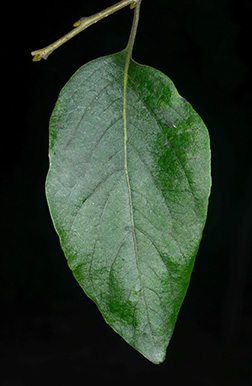
Leaf: Alternate, simple, oblong to oval, 2 1/2 to 5 inches long, pinnately-veined, margin entire, lustrous green above and paler or whitened below.
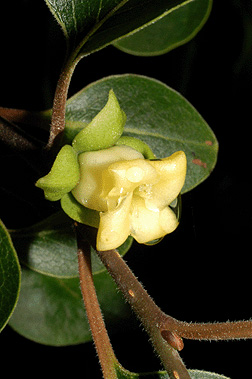
Flower: Species is usually dioecious; both white to greenish-white and about 1/2 inch long; male flowers in 3's; female flowers solitary and urn-shaped, appear in late spring and early summer.
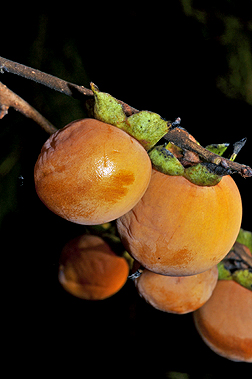
Fruit: A plum-like berry that is green before ripening, turning orange to black when ripe, 3/4 to 2 inches in diameter, leafy bracts on top of fruit. The fruit is very astringent and mouth numbing when green, sweet and edible when ripe after a hard freeze; matures in mid to late fall.
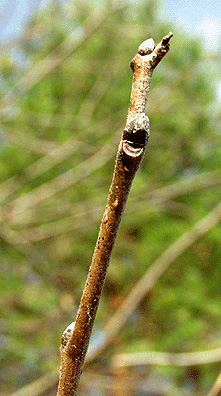
Twig: Slender, light brown to gray, maybe scabrous or pubescent; no true terminal bud and twig scar is often very prominent, buds triangular, appressed, dark red to black with 2 bud scales; leaf scar has one oval vascular bundle trace.
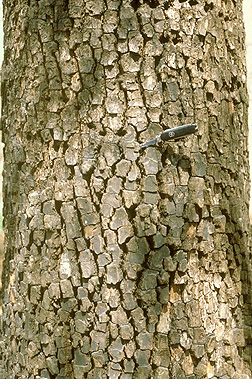
Bark: When young gray-brown with orange in fissures, later becoming much darker, breaking up into square scaly thick plates; reminiscent of charcoal briquettes (very unique).
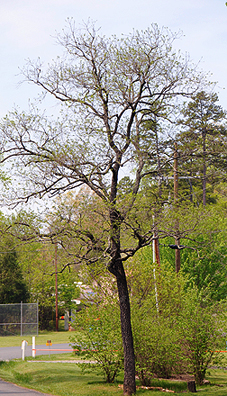
Form: A small to medium sized tree to 60 feet with a round-topped crown of crooked branches. In forest stands the stem may be straight, tall, and slender.
Looks like: blackgum
- sourwood
- sassafras
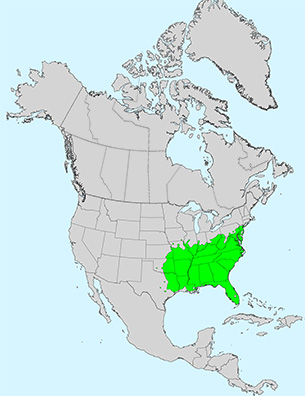
Additional Range Information: Diospyros virginiana is native to North America. Range may be expanded by planting. Download the full-size PDF map.
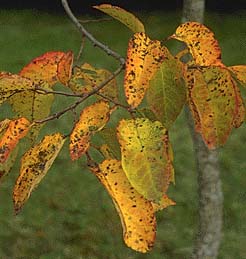
More Information: Fall Color
External Links: USDAFS Silvics of North America - USDAFS FEIS Silvics - USDA Plants Database - Horticulture Information - USDAFS Forest Products Lab
All material 2021 Virginia Tech Dept. of Forest Resources and Environmental Conservation; Photos and text by: John Seiler, Edward Jensen, Alex Niemiera, and John Peterson; Silvics reprinted from Ag Handbook 654; range map source information