 Virginia Tech Dendrology
bottlebrush buckeye Hippocastanaceae Aesculus
parviflora Walter

 symbol: AEPA2
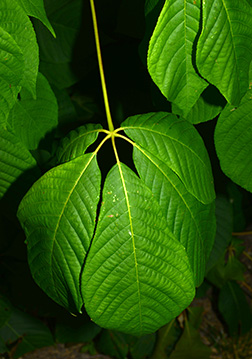
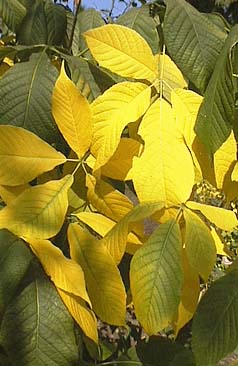
Leaf: Opposite, palmately compound, finely serrated margin, 5 to 7 leaflets, 4 to 8 inches long, green to dark green above, lighter and downy beneath.
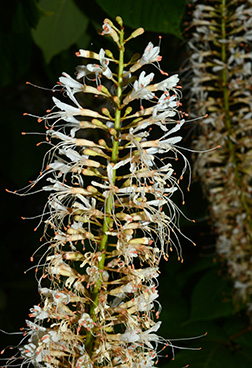
Flower: Clusters look like a bottle brush, individual flowers white, stamens 1/2 to 1 1/2 inches long and reaching past petals, produced on cylindrical panicles 8 to 12 inch long, and 2 to 4 inch wide, appearing in early summer.
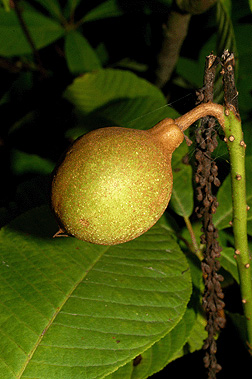
Fruit: Pear-shaped capsule, 2 to 3 inches long, 3 parted husks, light brown, smooth, ripen in early fall.
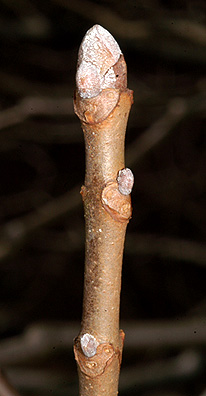
Twig: Stout, gray-brown, lighter lenticels, end buds large, orangish brown with gray cast (fuzz), 4 to 6 scales visible, large heart-shaped leaf scar.
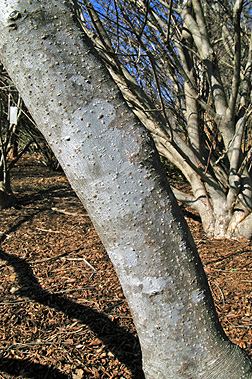
Bark: Smooth, lenticeled, gray to light reddish brown.
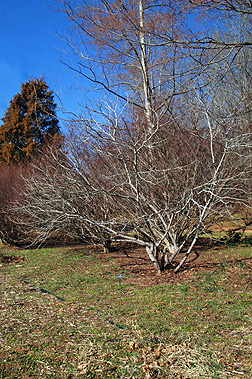
Form: Large shrub 8 to 15 feet tall; multistemmed and suckering, many upright, slender branches; wide-spreading crown, rarely reaching tree size.
Looks like: red buckeye
- painted buckeye
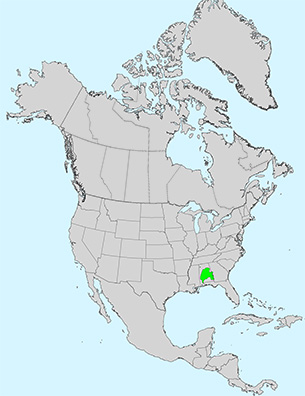
Additional Range Information: Aesculus parviflora is native to North America. Range may be expanded by planting. Download the full-size PDF map.
More Information: Fall Color
External Links: USDA Plants Database - Horticulture Information - USDAFS Forest Products Lab
All material 2025 Virginia Tech Dept. of Forest Resources and Environmental Conservation; Photos and text by: John Seiler, Edward Jensen, Alex Niemiera, and John Peterson; Silvics reprinted from Ag Handbook 654; range map source information