 Virginia Tech Dendrology
kousa dogwood Cornaceae Cornus
kousa Hance


 symbol: COKO2
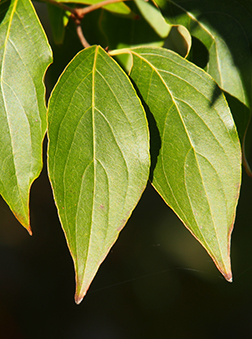
Leaf: Opposite, simple, oval to ovate with an entire margin, arcuate venation, 2 1/2 to 4 inches long, 2 to 2 1/2 inches wide, shiny dark green above, paler below with some tufts of golden-brown hair present particularly at base of petiole.
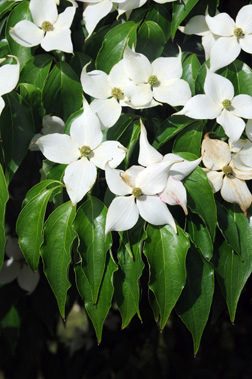
Flower: Species is monoecious; white to slightly yellow-white bracts surround a cluster of small inconspicuous flowers; white bracts are very showy, 2 to 3 inches across and often cover the entire plant in late spring (after flowering dogwood).
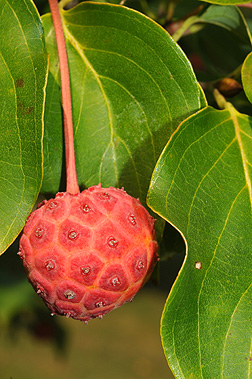
Fruit: Very unusual, edible drupe, light red to pink in color, round and 1 to 1 1/2 inches across; yellowish orange inside and contains stony pits, borne on a 1 1/2 to 2 inch stalk, ripen in late summer to early fall.
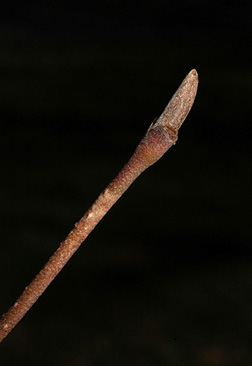
Twig: Slender, with initially some purple or green but later turning light brown; leaf buds resemble a cat claw, flower buds are considerably larger and heart-shaped.
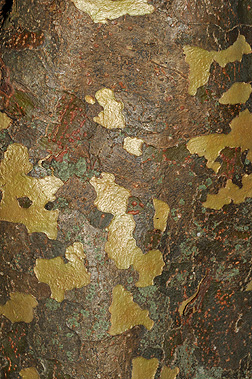
Bark: Initially smooth and light brown, later exfoliating into small patches forming a tan and brown camouflage pattern.
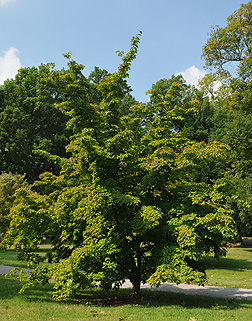
Form: Typically multiple stems, wide branching reaching a height of 30 feet.
Looks like: flowering dogwood
- Pacific dogwood
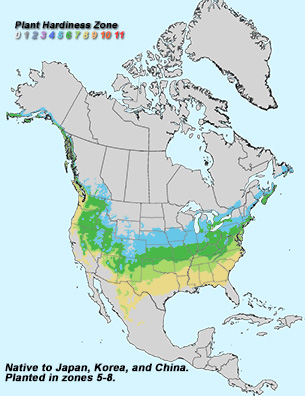
Additional Range Information: Cornus kousa is planted in the USDA hardiness zones shown above and is not known to widely escape cultivaton. Download the full-size PDF map.
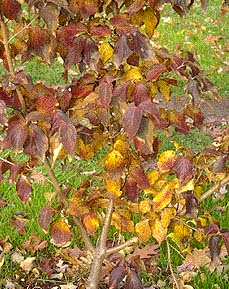
More Information: Fall Color
External Links: USDA Plants Database - Horticulture Information
All material 2025 Virginia Tech Dept. of Forest Resources and Environmental Conservation; Photos and text by: John Seiler, Edward Jensen, Alex Niemiera, and John Peterson; Silvics reprinted from Ag Handbook 654; range map source information