 Virginia Tech Dendrology
manuka Myrtaceae Leptospermum
scoparium J.R. Forst. & G. Forst.

 symbol: LESC2
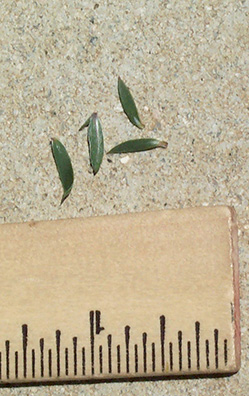
Leaf: Alternate, simple, evergreen, fragrant, lanceolate, to 1/2 to 1 inch long, spine tipped, shiny dark green to purplish above, paler below, entire margins.
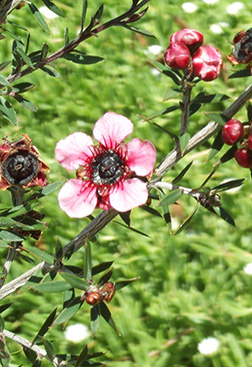
Flower: Very showy, to 1 inches across, with 5 large rounded dark pink or white petals; appearing early- to mid-summer; some cultivars produce double-flowers.
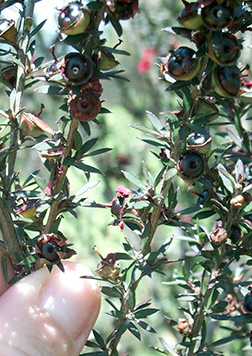
Fruit: A dark purple to black capsule that splits open along 5 seams, covered with a green cap, 3/8 inch wide.
Twig: Gray-green and lined to somewhat ridged.
Bark: Initially smooth and red-brown, developing scaly-topped ridges.
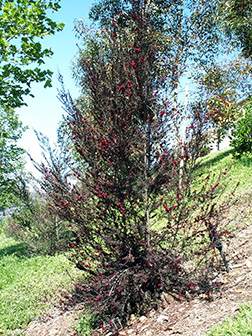
Form: A small densely-branched tree or a large shrub to 45 feet tall, but more commonly to 16 feet tall in cultivation.
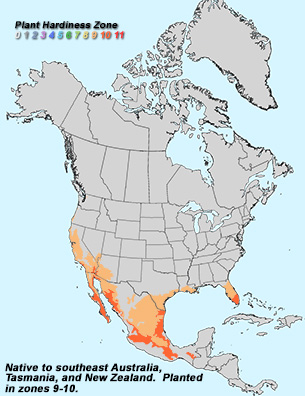
Additional Range Information: Leptospermum scoparium is planted in the USDA hardiness zones shown above and is not known to widely escape cultivaton. Download the full-size PDF map.
External Links: USDA Plants Database
All material 2021 Virginia Tech Dept. of Forest Resources and Environmental Conservation; Photos and text by: John Seiler, Edward Jensen, Alex Niemiera, and John Peterson; Silvics reprinted from Ag Handbook 654; range map source information