 Virginia Tech Dendrology
earleaf acacia Fabaceae Acacia
auriculiformis A. Cunn. ex Benth.

 symbol: ACAU
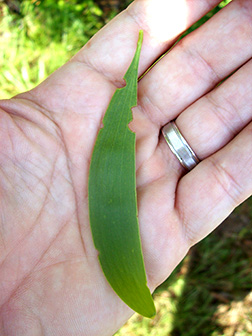
Leaf: Alternate, simple, evergreen and leathery, 4-6 long, 3/4 to 1 inch wide, curved, glaucus to dark green above and below; margins entire; venation parallel. Technically, these are reduced leaves with blade-like leaf stalks called "phyllodes".
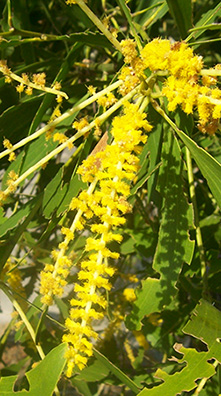
Flower: Species is monoecious; yellow, displayed in showy 3 inch spikes in leaf axils or at the branch tips, fragrant, appearing from spring through fall.
Fruit: A 2 to 3 inch long red-brown legume, flattened, initially straight but becoming very twisted; splitting at maturity to reveal black seeds attached by orange strings.
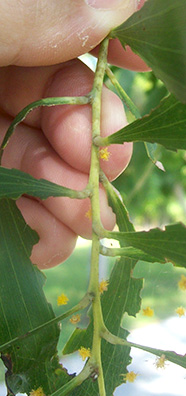
Twig: Glaucous green.
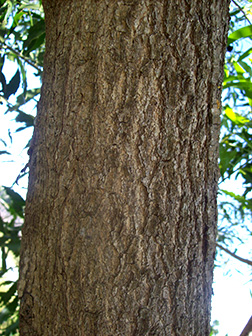
Bark: Gray-brown to black, becoming irregularly fissured.
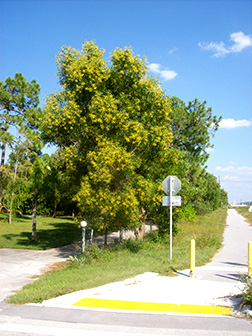
Form: A twisted tree with a round crown, to 100 feet tall in its native habitat but more commonly to 50 feet in Florida.
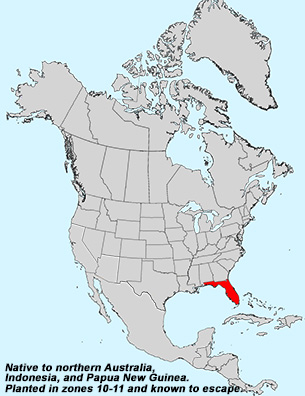
Additional Range Information: Acacia auriculiformis is planted in the USDA hardiness zones shown above and may seed into the landscape. Download the full-size PDF map.
External Links: USDA Plants Database - Horticulture Information
All material 2025 Virginia Tech Dept. of Forest Resources and Environmental Conservation; Photos and text by: John Seiler, Edward Jensen, Alex Niemiera, and John Peterson; Silvics reprinted from Ag Handbook 654; range map source information