 Virginia Tech Dendrology
mountain hemlock Pinaceae Tsuga
mertensiana (Bong.) Carrière

 symbol: TSME
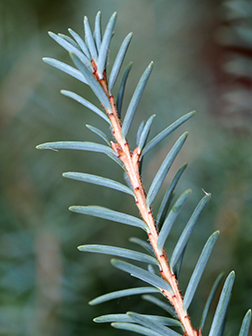
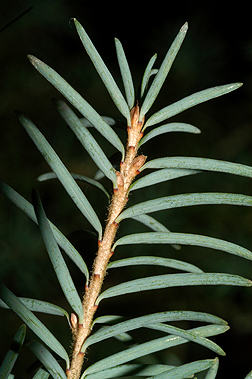
Leaf: Evergreen, flattened, single needles, spirally arranged (never 2-ranked); short (1/2 to 3/4 inch long) and thickened in cross section, uniform in color on all sides ranging from dark green to blue-green, rounded apexes, short but distinct petioles. Lateral branches are often very short, giving the appearance of star-shaped clusters of foliage.
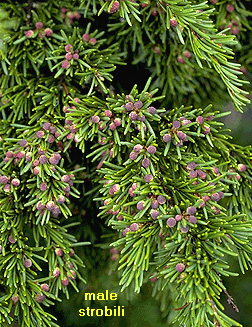
Flower: Species is monoecious; male cones are tiny, yellow, and occur axillary on previous year's growth; female cones are tiny, purple, and terminal.
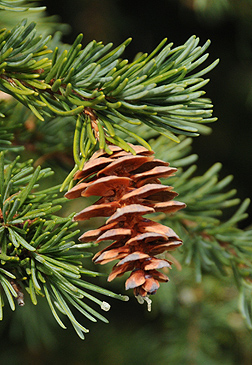
Fruit: Small woody cylindrical cones (1 to 3 inches long) with numerous thin, imbricate scales; pendent, sessile, and terminal; reddish brown; mature in one season.
Twig: Slender to moderately stout, and minutely pubescent, roughened by diagonally-raised and rounded leaf scars; main branches contain numerous short lateral branches.
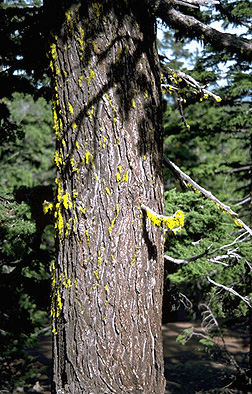
Bark: Young bark is thin, superficially scaly, and brown to black; on mature trees, bark is thin (1 to 2 inches) with narrow rounded ridges, reddish brown in color.
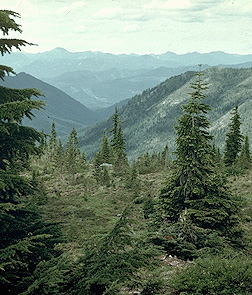
Form: A small, high elevation, evergreen conifer that grows 60 to 100 feet tall and 2 to 3 feet in diameter. Mature trees have a pyramidal crown with dense, tight foliage.
Looks like: western hemlock
- eastern hemlock
- Carolina hemlock
- Pacific yew
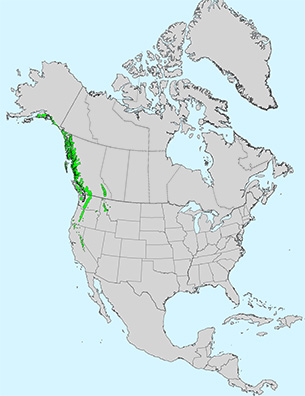
Additional Range Information: Tsuga mertensiana is native to North America. Range may be expanded by planting. Download the full-size PDF map.
External Links: USDAFS Silvics of North America - USDAFS FEIS Silvics - USDA Plants Database - USDAFS Forest Products Lab
All material © 2021 Virginia Tech Dept. of Forest Resources and Environmental Conservation; Photos and text by: John Seiler, Edward Jensen, Alex Niemiera, and John Peterson; Silvics reprinted from Ag Handbook 654; range map source information