 Virginia Tech Dendrology
Jeffrey pine Pinaceae Pinus
jeffreyi Balf.

 symbol: PIJE
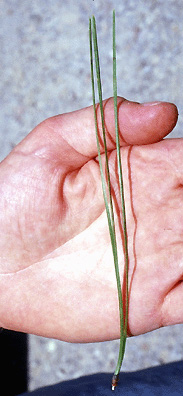
Leaf: Evergreen needles, 5 to 11 inches long, fascicles of 3 (occasionally 2), dark blue-green without bloom, often twisted, persist 5 to 8 years, bundle sheath is persistent.
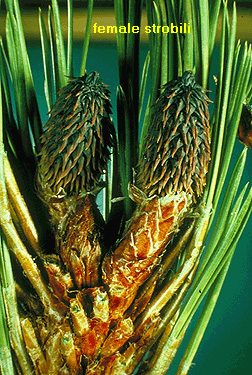
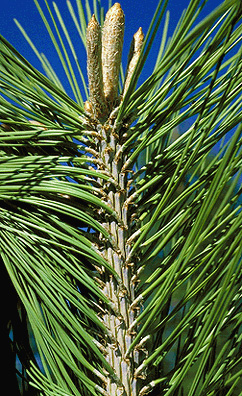
Flower: Species is monoecious; very similar to ponderosa pine; male cones are long (up to 2 inches), cylindrical, red, and borne terminally; female cones are nearly round, red, and borne terminally.
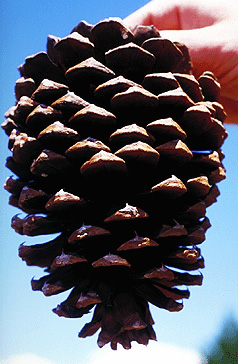
Fruit: Large woody cone, 5 to 9 inches long; broadly egg-shaped and reddish brown when mature; imbricate scales end in a dorsal umbo with a distinctly recurved prickle.
Twig: Current year twigs are covered with a purplish white bloom that disappears with time; cut twigs have a sweet fruity odor.
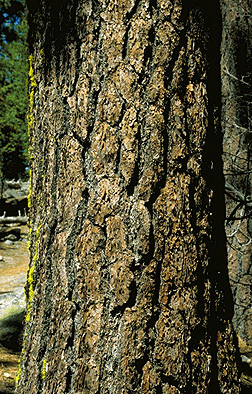
Bark: Young bark is thin and scaly, brown to black in color. Mature bark is thick with broad, flat, scaly plates, orange-red to cinnamon-red in color, pineapple odor when cut. Bark is similar to ponderosa pine but often a bit redder.
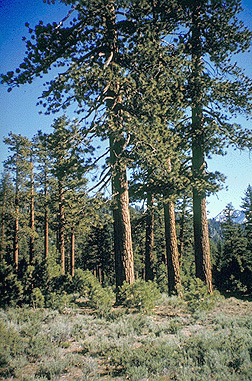
Form: A large evergreen conifer growing 80 to 140 feet tall and 3 to 4 feet in diameter.
Looks like: ponderosa pine
- knobcone pine
- Coulter pine
- Monterey pine
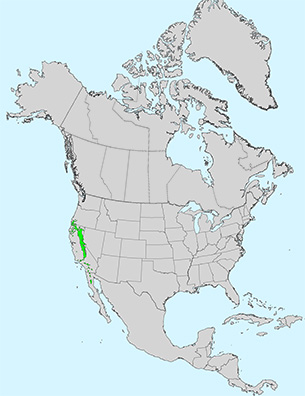
Additional Range Information: Pinus jeffreyi is native to North America. Range may be expanded by planting. Download the full-size PDF map.
External Links: USDAFS Silvics of North America - USDAFS FEIS Silvics - USDA Plants Database - USDAFS Forest Products Lab
All material © 2021 Virginia Tech Dept. of Forest Resources and Environmental Conservation; Photos and text by: John Seiler, Edward Jensen, Alex Niemiera, and John Peterson; Silvics reprinted from Ag Handbook 654; range map source information