 Virginia Tech Dendrology
Alcock's Spruce Pinaceae Picea
alcoquiana Veitch ex Lindl. Carriére

 symbol:
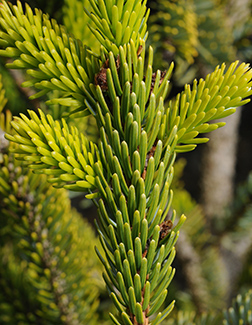
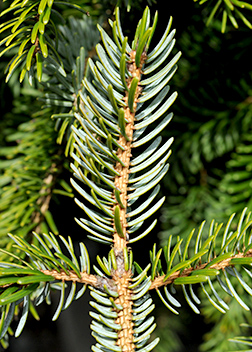
Leaf: Evergreen needles, 1/2 inch long, sharp pointed, yellow-green above in sharp contrast with the blue-white with stomatal bands on the lower surfaces; each needle borne on a raised, woody peg (sterigma).
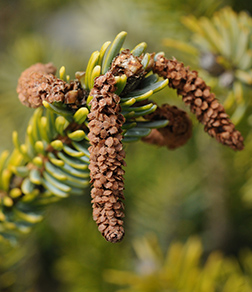
Flower: Species is monoecious; males emerge reddish purple and ripen to yellow-brown, scattered throughout trees; females purple, upright, in tops of the trees; appearing early summer.
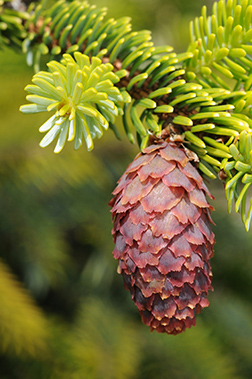
Fruit: Cones are 2 to 4 inches long, cylindrical, light brown in color, scales are flexible, pointed with jagged erose margins, mature in the fall.
Twig: Red-brown or gray-brown, mostly hairless; needles are borne on woody pegs; bud scales brown and resinous.
Bark: Gray to red-brown, young trees with small, thin scales; older trees still scaly but with shallow furrows.
Form: A medium to large tree with pyramidal form reaching up to 100 feet tall.
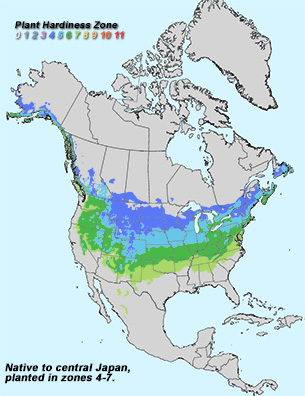
Additional Range Information: Picea alcoquiana is planted in the USDA hardiness zones shown above and is not known to widely escape cultivaton. Download the full-size PDF map.
External Links:
All material © 2021 Virginia Tech Dept. of Forest Resources and Environmental Conservation; Photos and text by: John Seiler, Edward Jensen, Alex Niemiera, and John Peterson; Silvics reprinted from Ag Handbook 654; range map source information